

Inside the Lab: What Sets These GLP-1 Peptides Apart
In the realm of research peptides, Semaglutide, Tirzepatide, and Retatrutide have generated significant interest due to their innovative mechanisms and potential roles in metabolic pathway research. These peptides are primarily explored for their roles in modulating metabolic pathways, particularly focusing on glucose regulation and energy balance. This article delves into the comparative aspects of these peptides, based on available research, to provide insights into their functionalities and implications in laboratory settings.
Disclaimer: All compounds mentioned in this article are intended strictly for laboratory research use only. They are not approved for human consumption, clinical use, or therapeutic applications. The information provided is for educational and investigational purposes only.
Background: GLP-1 Receptor Signaling & Incretin Networks
Research peptides are short chains of amino acids used extensively in scientific studies to understand biological processes. These peptides act as building blocks in the study of various physiological functions, offering a window into the intricate workings of cellular mechanisms. They are pivotal in drug discovery and investigational research, offering insights into complex pathways. Furthermore, their ability to mimic natural biological processes makes them indispensable tools for investigating potential mechanisms across domains, including metabolism and neurobiology.
The versatility of research peptides stems from their ability to bind to specific receptors and activate intracellular signaling cascades. This specificity is central to research focused on targeted outcomes and minimizing off-target effects. In metabolic pathway research, peptides like Semaglutide, Tirzepatide, and Retatrutide are frequently studied due to their receptor selectivity.
The GLP-1 receptor is an area of interest in metabolic signaling studies¹. It is involved in insulin-related mechanisms and energy regulation¹. Research peptides like Semaglutide and Tirzepatide are studied for their activity on this receptor, contributing to research in glucose metabolism and nutrient absorption¹.
GLP-1 receptor activation has also been studied in the context of cardiovascular signaling, inflammatory response, and cellular stress regulation². As scientists continue to explore this pathway, new insights into physiological signaling networks may emerge².

Semaglutide lab use is a GLP-1 agonist commonly studied in research for its roles in glucose-related signaling and metabolic function.³ In research models, it is examined in relation to insulin-related signaling and appetite-related pathways.³ Its activity has also been studied alongside cardiovascular biomarkers in lab studies, making it a focal point in metabolic research.
Semaglutide in Lab Use
- Semaglutide binds to the GLP-1 receptor, where it has been shown to stimulate insulin release and inhibit glucagon secretion in preclinical models.³
- Its activity in modulating blood-glucose signals and influencing satiety pathways has been extensively studied in non-human research. Researchers are also exploring Semaglutide in models of neuroendocrine signaling, particularly regarding satiety and food-intake mechanisms.³
Furthermore, ongoing preclinical studies are exploring Semaglutide’s activity in neurological signaling pathways, including its potential effects in models related to neurodegeneration.³ Its broad receptor activity makes it a compound of interest in multi-system investigational research. As researchers continue to examine its molecular interactions, Semaglutide remains a valuable tool for studying complex biological processes across multiple physiological systems.³
Benefits and Considerations
Semaglutide’s receptor activity related to glucose regulation and energy balance has made it a focus of ongoing metabolic research.³ Its interaction with GLP-1 pathways has also been studied in relation to cardiovascular biomarkers in laboratory models.² While its extended half-life and sustained-release profile are of interest for long-duration studies, researchers must carefully consider dosing protocols and timing to ensure consistency and reliability in experimental outcomes.
Moreover, the financial considerations associated with incorporating Semaglutide into laboratory research may influence study design, particularly in long-term or multi-variable experiments. Researchers should also account for variability in biological response observed in preclinical models, as this can impact the reproducibility and interpretation of findings. As interest in this peptide grows, ongoing studies continue to refine laboratory protocols to support consistent and reliable data collection.
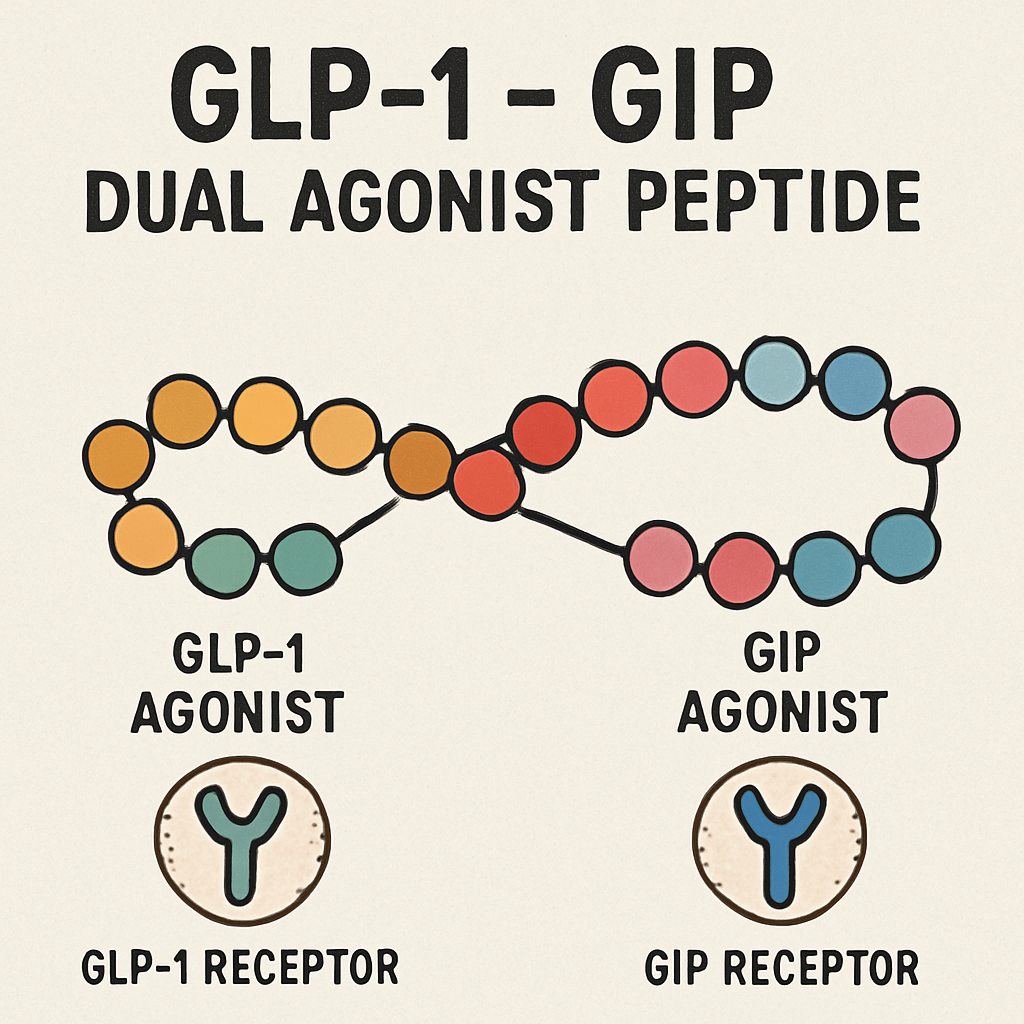
Tirzepatide: The Dual Agonist
Tirzepatide is a novel research peptide that acts as a dual agonist of the GLP-1 and GIP (glucose-dependent insulinotropic polypeptide) receptors.⁴ This dual receptor activity has made it a focus of laboratory investigations related to metabolic signaling.⁴ By engaging two distinct pathways, Tirzepatide offers a unique model for studying the interaction of incretin hormones in research focused on energy balance and glucose regulation.⁴
Tirzepatide Peptide Insights
- Mechanism of Action: Tirzepatide targets both GLP-1 and GIP receptors; this allows researchers to investigate the interactions of dual incretin pathways in metabolic studies.⁴
- Research Applications: Tirzepatide is currently under investigation for its synergistic effects on insulin-related signaling and energy regulation. Its dual activity provides researchers with an opportunity to study multiple hormonal pathways simultaneously in metabolic models.⁴
The investigational scope of Tirzepatide has expanded beyond glucose metabolism, with ongoing studies examining its activity in models related to liver function and endocrine signaling.⁴ As research continues, this peptide may serve as a valuable tool for exploring complex interactions within metabolic pathways, contributing to a broader understanding of multi-receptor hormone modulation.
Advantages and Challenges
Tirzepatide’s dual pathway activation offers advantages in metabolic research. Its multifaceted action holds promise for advancing studies focused on energy regulation, glucose balance, and hormone signaling. However, researchers must navigate the complexities of its dual mechanism to harness its full potential in controlled experimental settings. Understanding the interplay between GLP-1 and GIP pathways remains essential for designing precise protocols and generating reliable results.⁶
Moreover, development-related challenges such as production scalability and compound stability may influence how widely Tirzepatide is used in long-term research. As studies progress, efforts to refine its formulation and delivery methods continue to play a critical role in expanding its utility. With careful design and innovation, Tirzepatide stands out as a leading candidate in the ongoing exploration of multi-pathway metabolic compounds.
Retatrutide: The Triple Agonist

Retatrutide, a triple agonist research peptide, stands out for its ability to target GLP-1, GIP, and glucagon pathways.⁵ This multi-faceted approach positions it uniquely in metabolic research, with potential relevance for investigating broad-spectrum hormone signaling.⁵ By simultaneously engaging multiple receptors, Retatrutide allows researchers to explore complex interactions that may influence energy regulation and nutrient metabolism across multiple systems.⁵
Retatrutide Compound Dynamics
- Mechanism of Action: By engaging GLP-1, GIP, and glucagon pathways, Retatrutide enables a multi-receptor approach to studying metabolic signaling. This triple action has drawn interest for its potential to influence energy expenditure, nutrient utilization, and insulin-related pathways in research settings—offering broader insight than what may be observed with single or dual agonists.⁵
- Research Applications: Retatrutide’s triple agonist profile has become a focus in studies exploring broader aspects of metabolic signaling. Researchers are investigating its potential role in models related to energy balance, glucose regulation, and hepatic function. In addition, early-stage studies are examining how simultaneous activation of GLP-1, GIP, and glucagon receptors may impact key biomarkers linked to lipid metabolism and overall metabolic efficiency. This compound’s unique receptor activity continues to expand its utility in advanced metabolic research models.⁵
The triple agonist nature of Retatrutide presents both opportunities and challenges.⁵ While its broad receptor activity offers promising avenues for metabolic research, the complexity of its interactions requires careful study and precise modeling.⁵ Understanding the nuanced effects of simultaneous receptor activation remains essential to fully explore the compound’s scientific potential.
Pros and Cons
The triple action of Retatrutide presents a compelling opportunity in metabolic research. Its ability to target multiple pathways simultaneously makes it a valuable tool for studying complex hormonal networks and their potential impact on energy metabolism. However, its multifaceted mechanism also introduces challenges in experimental design, requiring researchers to account for receptor cross-talk and system-wide variability.
In addition, the complexity of Retatrutide’s activity highlights the need for precise dosing protocols and long-term observation in controlled lab settings. As research continues, scientists aim to refine how this compound is applied in various models to better understand its full investigational potential.
Comparative Analysis
Observations in Metabolic Research Models
- Semaglutide: Semaglutide has demonstrated strong activity in studies focused on glucose regulation and appetite-related signaling. Its interaction with the GLP-1 receptor has also made it a compound of interest in research involving cardiovascular biomarkers.³
- Tirzepatide: Tirzepatide’s dual agonist activity has shown promising results in GLP-1 agonist research models, particularly in relation to nutrient processing, insulin signaling, and lipid metabolism. Its effects on inflammatory markers are also being explored in ongoing preclinical studies.⁴
- Retatrutide: Retatrutide offers a broad scope of investigation through its triple agonist mechanism. By engaging GLP-1, GIP, and glucagon receptors, it provides researchers with a unique tool to study complex hormonal interactions across multiple metabolic pathways.⁵
The comparative use of these GLP-1 research peptides in metabolic research highlights the importance of targeted receptor modeling. Each compound presents distinct characteristics that support ongoing investigations into energy balance, hormone signaling, and nutrient regulation. As the field evolves, understanding these mechanisms more deeply will help refine how researchers apply them in diverse study models
Safety and Tolerability in Research
Safety profiles of these peptides play an important role in evaluating their suitability for ongoing laboratory studies. While all three compounds have shown consistent performance in controlled research environments, scientists continue to examine their long-term behavior, including receptor-specific responses and compound stability over time.
Current investigations are focused on understanding how extended exposure to these peptides may affect biological markers in preclinical models. As studies progress, the development of standardized research protocols and best practices will help ensure reproducibility and reliable data collection across study designs. These efforts remain essential to advancing responsible and well-informed peptide research.
Future Directions in Research
The evolution of research peptides like Semaglutide, Tirzepatide, and Retatrutide continues to shape new possibilities in metabolic science. Future studies are expected to focus on refining how these compounds interact with hormonal pathways, with growing interest in their potential relevance beyond traditional metabolic models. Ongoing investigations are also exploring their activity in research related to cardiovascular signaling and neuroendocrine function.
In parallel, advancements in peptide synthesis and delivery technologies may improve how these compounds are utilized in controlled research settings. As researchers continue to explore structural variations and novel administration techniques, the scientific understanding of these multi-receptor peptides will likely deepen. The continued pursuit of knowledge in this area supports more precise modeling of complex biological systems and expands opportunities for discovery across multiple domains of peptide research.
Conclusion
In the ever-evolving landscape of metabolic peptide research, Semaglutide, Tirzepatide, and Retatrutide continue to offer valuable insights into receptor-specific signaling and hormonal regulation. Their distinct mechanisms highlight the importance of targeted pathway investigation and underscore their relevance in scientific exploration.
As studies progress, these peptides may help expand our understanding of complex biological systems and metabolic networks. Ongoing research continues to deepen the field’s knowledge base, providing new opportunities to model multi-receptor interactions and explore emerging directions in peptide science.
References
- Drucker DJ. Mechanisms of Action and Therapeutic Application of GLP-1. Cell Metabolism. 2018. PubMed
- Mahapatra MK, et al. Semaglutide: GLP-1 receptor agonist—mechanisms and evidence. Open-access review, 2022.
- Min T, Bain SC. Tirzepatide: dual GIP/GLP-1 receptor agonist—mechanistic review. 2020.
- Jastreboff AM, et al. Retatrutide (GLP-1/GIP/glucagon receptor agonist): Phase 2 investigation. 2023.
- Zheng Z, et al. GLP-1 receptor: mechanisms and updates. 2024. Nature portfolio
- Fukuda M, et al. GIP receptor roles in metabolism/CNS: review. 2021.
To read more articles like this, check out our Peptide Research Articles, where we explore the latest advancements is peptide research and trending peptide data sets.